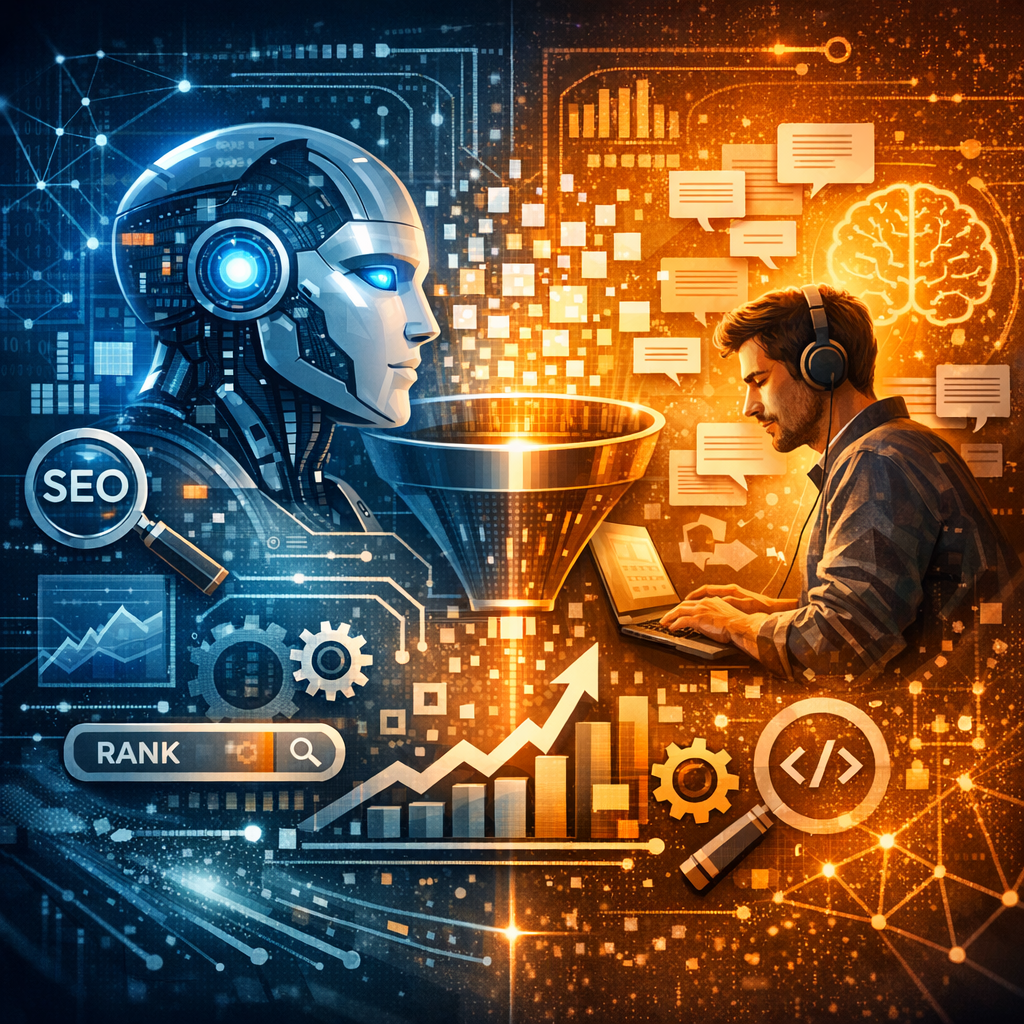
The Future of SEO: How AI is Shaping the Digital Landscape for Marketing Professionals
—
Introduction:
In today’s rapidly evolving digital environment, SEO is no longer just about keywords and backlinks. As we stand on the brink of a technological revolution, artificial intelligence (AI) is emerging as a game-changer in the world of SEO and digital marketing. For C-suite marketing and SEO professionals, understanding and leveraging AI can mean the difference between leading the market or falling behind. But what exactly is AI’s role in SEO, and how can it provide tangible benefits to businesses looking to optimize their digital presence?
AI’s integration into SEO processes offers a transformative approach to how content is created, curated, and consumed. For starters, AI can analyze vast amounts of data more efficiently than traditional methods, uncovering patterns and insights that would otherwise remain hidden. This capability is crucial in adapting to continuously changing search engine algorithms, allowing businesses to maintain or improve their search rankings proactively.
Moreover, AI-powered tools like natural language processing (NLP) are revolutionizing how content is crafted by enabling machines to understand and generate human-like text. This development is vital for marketers aiming to produce content that genuinely resonates with their target audiences. By understanding user intent better than ever before, AI can help tailor content to meet the specific needs and preferences of a consumer base, thereby enhancing user engagement and conversion rates.
Another area where AI is making significant strides is in predictive analytics. By analyzing historical data and using machine learning algorithms, businesses can predict future trends and consumer behavior with remarkable accuracy. This predictive capability empowers marketing and SEO professionals to develop strategies that are not only reactive but also anticipatory, keeping them one step ahead of the competition.
Finally, AI’s role in automating routine SEO tasks allows professionals to focus on more strategic initiatives. Tasks like keyword research, SEO audits, and performance tracking can be managed more efficiently through AI, reducing human error and increasing productivity. As a result, businesses can allocate resources more effectively, maximizing their ROI from SEO initiatives.
—
Features:
Numerous academic and professional studies highlight the profound impact of AI on the SEO landscape. A study published in [*Expert Systems with Applications*](https://www.journals.elsevier.com/expert-systems-with-applications) emphasizes AI’s potential in enhancing SEO through advanced data processing and analysis capabilities, which are pivotal in accurately predicting search engine behaviors and trends.
Another relevant study, appearing in the [*Journal of Marketing Research*](https://www.journals.ama.org/journal-of-marketing-research), discusses the implementation of machine learning algorithms in optimizing digital marketing strategies. This research shows how AI can help effectively automate the A/B testing process, providing marketers with insights into which content strategies yield the highest conversions effectively.
Furthermore, Google itself has increasingly embraced AI technologies to improve search results, as seen with the implementation of BERT (Bidirectional Encoder Representations from Transformers). BERT helps Google better understand natural language queries, which reflects the growing importance of AI in shaping search engine algorithms [link to Google’s BERT announcement](https://www.blog.google/products/search/search-language-understanding-bert).
On the medical front, AI’s application in data analytics parallels its benefits to SEO, as detailed in an article from the [*Journal of Medical Internet Research*](https://www.jmir.org/). This article highlights AI’s ability to handle large datasets, drawing parallels between medical decision-making processes and SEO strategies, where large-scale data processing is crucial.
These studies underscore AI’s transformative potential across different industries, including digital marketing and SEO. They also illustrate how AI not only enhances traditional practices but also fosters innovation by opening new avenues for digital engagement and strategy development.
—
Conclusion:
As AI continues to develop, its integration into SEO and digital marketing will become increasingly indispensable. For C-suite professionals, understanding AI’s nuances and potential applications is crucial for staying competitive in a crowded digital landscape. By leveraging AI’s capabilities, businesses can create highly tailored strategies that enhance customer engagement, improve search rankings, and maximize ROI. To thrive in the future of SEO, embracing AI is not just an option—it is a necessity.
—
Summary:
In the evolving world of digital marketing, integrating AI into SEO strategies is key for staying competitive. AI brings efficiencies in data analysis, personalized content creation through NLP, and anticipatory strategies via predictive analytics. Automated SEO tasks and insights into user behavior can significantly enhance marketing effectiveness. Studies emphasize AI’s transformative impact across industries, including Google’s use of BERT for refining search results. For marketing professionals, it’s crucial to embrace AI’s capabilities to enhance user engagement, improve search rankings, and maximize ROI in order to lead in the digital space.

Dominic E. is a passionate filmmaker navigating the exciting intersection of art and science. By day, he delves into the complexities of the human body as a full-time medical writer, meticulously translating intricate medical concepts into accessible and engaging narratives. By night, he explores the boundless realm of cinematic storytelling, crafting narratives that evoke emotion and challenge perspectives.
Film Student and Full-time Medical Writer for ContentVendor.com